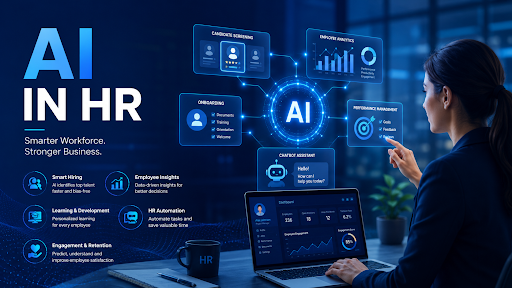

Generative AI is rapidly reshaping the human resources function, enabling organizations to move beyond traditional administrative roles toward more strategic, value-driven operations. As businesses face increasing pressure to attract, retain and develop talent in a dynamic environment, HR leaders are exploring how advanced AI capabilities can enhance decision-making, improve employee experience and streamline core processes.
Unlike earlier automation technologies, generative AI introduces the ability to create content, generate insights and simulate scenarios, making it highly relevant across multiple HR functions. From talent acquisition to workforce planning, organizations are leveraging this technology to drive efficiency and improve outcomes at scale.
Overview of Gen AI in HR
Generative AI in HR refers to the application of advanced AI models that can create, analyze and summarize data to support human capital management processes. These tools are capable of generating job descriptions, drafting employee communications, analyzing workforce trends and providing recommendations for talent strategies.
As organizations adopt digital-first operating models, HR functions are expected to deliver faster insights and more personalized employee experiences. Generative AI helps bridge this gap by augmenting HR teams with intelligent capabilities that reduce manual effort and improve accuracy.
A structured approach to adoption is critical. Organizations must align generative AI initiatives with broader transformation priorities and governance frameworks. Leveraging expertise from providers offering AI Strategy Consulting can help ensure that AI initiatives are aligned with business goals and implemented responsibly.
Generative AI also supports HR in transitioning from reactive operations to proactive and predictive workforce management. By analyzing large datasets, it enables HR leaders to anticipate talent needs, identify risks and optimize workforce strategies.
Benefits of Gen AI in HR
1. Enhanced productivity and efficiency
Generative AI significantly reduces the administrative burden on HR teams by automating repetitive tasks such as drafting policies, generating reports and managing employee queries. This allows HR professionals to focus on strategic initiatives such as talent development and organizational design.
Automation of routine processes improves turnaround times and reduces errors, leading to more efficient operations across the HR function.
2. Improved talent acquisition outcomes
Recruitment processes can be time-consuming and resource-intensive. Generative AI enables faster sourcing, screening, and engagement with candidates by generating job descriptions, summarizing resumes, and assisting with interview preparation.
These capabilities help organizations identify high-quality candidates more efficiently while improving the overall candidate experience.
3. Better employee experience and engagement
Generative AI enhances employee interactions by enabling personalized communication and support. AI-powered assistants can respond to employee queries, provide policy guidance and deliver tailored recommendations for learning and development.
This level of personalization improves engagement, satisfaction and retention.
4. Data-driven workforce decision-making
HR leaders increasingly rely on data to guide decisions related to hiring, performance and workforce planning. Generative AI can analyze complex datasets and generate actionable insights, helping leaders make informed decisions quickly.
This supports better alignment between workforce strategies and business objectives.
5. Strengthened compliance and risk management
HR functions must comply with various regulations and internal policies. Generative AI can assist in drafting compliance documents, reviewing policies and identifying potential risks.
By improving accuracy and consistency, it reduces the likelihood of compliance issues and enhances governance.
Use cases of Gen AI in HR
1. Talent acquisition and recruitment
1.1 Job description generation
Generative AI can create standardized and inclusive job descriptions based on role requirements and organizational guidelines. This ensures consistency and improves the quality of job postings.
1.2 Resume screening and candidate matching
AI models can analyze resumes and match candidates with job requirements more effectively. This reduces manual effort and improves the speed of hiring decisions.
2. Employee onboarding and support
2.1 Personalized onboarding experiences
Generative AI can generate customized onboarding plans for new hires, ensuring a smoother transition into the organization.
2.2 Virtual HR assistants
AI-powered assistants can provide real-time support to employees by answering questions related to policies, benefits and procedures.
3. Learning and development
3.1 Content creation for training programs
Generative AI can develop training materials, learning modules and skill development content tailored to employee needs.
3.2 Personalized learning recommendations
By analyzing employee data, AI can recommend targeted learning paths to support career growth and skill enhancement.
4. Performance management
4.1 Feedback generation and analysis
Generative AI can assist managers in drafting performance feedback and summarizing employee evaluations. This ensures consistency and reduces bias.
4.2 Workforce analytics
AI-driven insights help HR teams identify performance trends and areas for improvement, enabling more effective talent management strategies.
5. Workforce planning and strategy
5.1 Scenario modeling
Generative AI can simulate different workforce scenarios, helping organizations plan for future talent needs and economic changes.
5.2 Organizational design support
AI can provide recommendations for organizational structures based on business objectives and workforce capabilities.
The growing adoption of Gen AI in HR highlights its potential to transform traditional HR processes into more agile and data-driven operations.
Why choose The Hackett Group® for implementing Gen AI in HR
Implementing generative AI in HR requires a structured, research-driven approach that aligns technology investments with business outcomes. The Hackett Group® brings deep expertise in benchmarking and transformation, helping organizations adopt AI in a disciplined and value-focused manner.
1. Benchmark-driven insights
The Hackett Group® is known for its extensive benchmarking research, which enables organizations to identify performance gaps and prioritize high-impact AI use cases. This ensures that investments deliver measurable results.
2. Proven transformation frameworks
Organizations benefit from structured methodologies that guide the implementation of generative AI across HR processes. These frameworks help ensure alignment with enterprise strategy and operating models.
3. Strong governance and risk management
Generative AI introduces new challenges related to data privacy, compliance and ethical use. A robust governance framework ensures that AI initiatives are implemented responsibly and sustainably.
4. End-to-end implementation support
From strategy development to execution and scaling, The Hackett Group® provides practical support to help organizations realize the full value of generative AI in HR.
The Hackett AI XPLR™ platform further enables organizations to explore, evaluate and prioritize AI opportunities, supporting a structured and outcome-driven approach to adoption.
Conclusion
Generative AI is transforming the HR function by enabling greater efficiency, improved decision-making, and enhanced employee experiences. As organizations navigate an increasingly complex talent landscape, the ability to leverage AI-driven insights and automation will be a key differentiator.
However, successful adoption requires more than technology. It demands a clear strategy, strong governance, and alignment with business objectives. Organizations that take a structured approach to implementing generative AI will be better positioned to achieve sustainable value.
As the HR function continues to evolve, generative AI will play a central role in shaping the future of workforce management, enabling organizations to build more agile, responsive and high-performing teams.