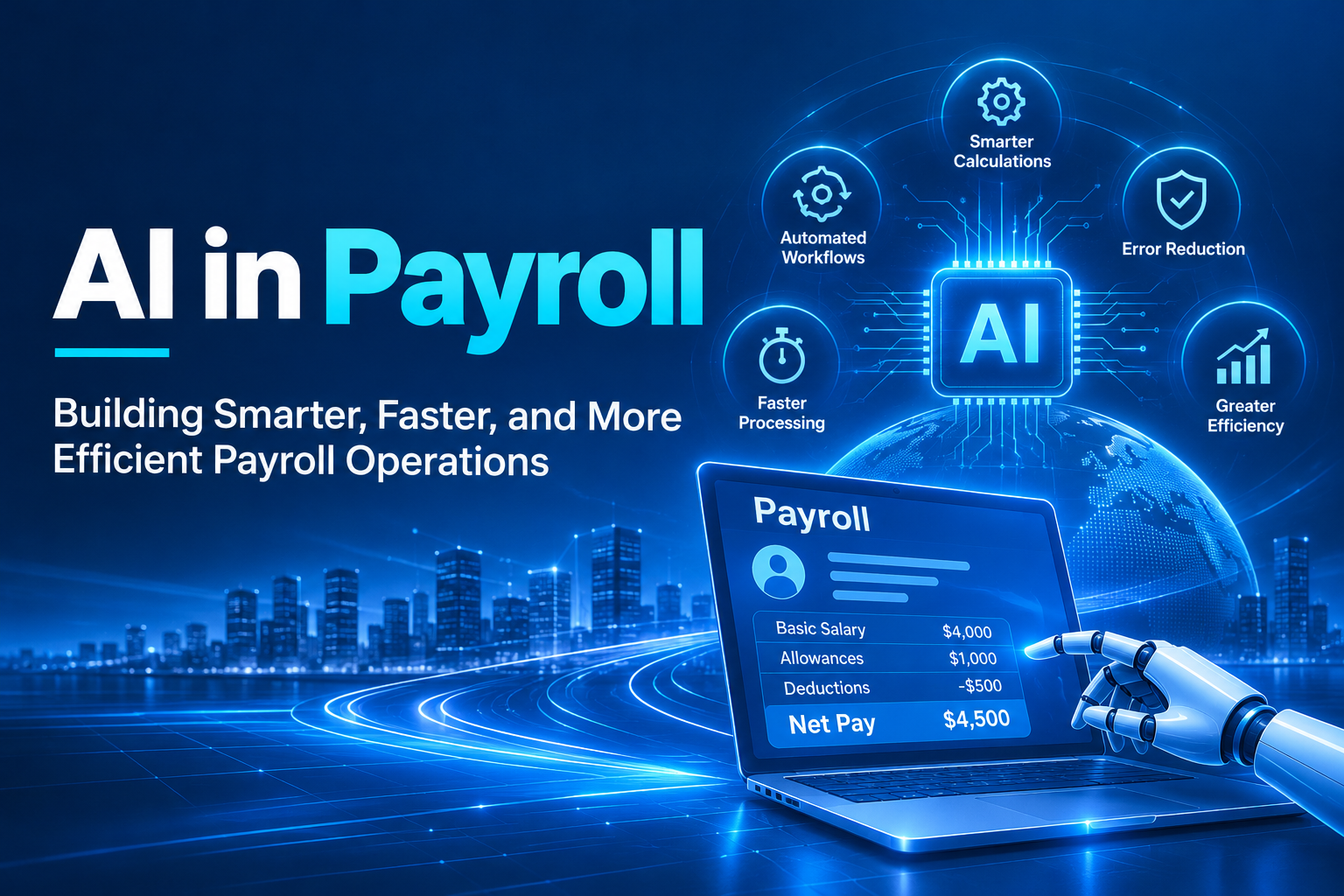
Payroll is becoming more complex as organizations manage distributed workforces, changing regulations, multiple compensation structures, and growing employee expectations. AI in payroll is helping organizations address these challenges by improving accuracy, automating repetitive work, and enabling payroll teams to focus on higher-value activities.
Why AI Is Becoming Important for Payroll
Payroll teams traditionally spend significant time on repetitive calculations, data validation, compliance checks, employee queries, and administrative processes. AI can reduce this workload while helping organizations create more consistent and reliable payroll operations.
Improving accuracy across payroll processes
AI payroll capabilities can identify unusual transactions, missing information, duplicate records, and potential calculation errors before payroll is finalized. By applying intelligent validation across payroll operations, organizations can reduce manual corrections and improve confidence in payroll results.
Supporting modern payroll functions
As payroll functions expand beyond salary calculations, organizations need technology that can support compliance, workforce changes, reporting, and employee services. AI can connect information across the payroll system, helping teams manage complex processes with greater speed, consistency, and visibility.
How AI Can Transform Payroll Operations
AI creates opportunities to move payroll from a largely transactional function toward a more intelligent and proactive business capability. Organizations can use AI to identify patterns, automate decisions, and improve how payroll teams respond to changing business requirements.
Automating repetitive payroll activities
AI can automate routine activities such as data validation, payroll inquiries, reconciliation, exception identification, and reporting. This allows payroll professionals to spend less time handling repetitive work and more time improving payroll strategy, controls, employee experience, and overall operational performance.
Strengthening payroll decision-making
AI can analyze historical payroll information and operational patterns to identify recurring issues and potential risks. These insights can support better payroll strategy by helping organizations understand process bottlenecks, workforce trends, cost drivers, and opportunities for operational improvement.
Building More Intelligent Payroll Solutions
The value of AI depends on how effectively it is integrated into existing processes and technology. Organizations need to consider data quality, governance, security, technology architecture, and workforce readiness when introducing AI capabilities into payroll environments.
Connecting AI with existing payroll systems
AI does not necessarily require organizations to replace their existing payroll system. Instead, AI capabilities can complement established platforms by improving data analysis, workflow automation, exception management, and employee support while maintaining existing operational structures and controls.
Enhancing employee-facing payroll services
Employees increasingly expect fast and accurate answers about pay, deductions, benefits, tax information, and payroll policies. AI-enabled payroll services can provide more responsive support by helping employees access relevant information and resolve routine questions without extensive manual intervention.
Managing AI Adoption in Payroll
Successful AI adoption requires more than selecting a technology platform. Payroll leaders need a structured approach that aligns AI capabilities with business priorities, operational requirements, governance standards, and measurable outcomes.
Creating a practical AI transformation roadmap
A focused AI transformation approach can help organizations prioritize payroll processes based on business value, complexity, risk, and automation potential. Starting with high-volume and repetitive activities can create measurable improvements while allowing teams to build confidence with AI gradually.
Measuring AI performance and business value
Organizations should establish clear measures for AI performance, including processing efficiency, error reduction, employee experience, cost savings, and productivity improvements. Tracking these outcomes helps payroll leaders understand whether AI investments are delivering sustainable operational value rather than simply introducing new technology.
The Role of AI Consulting in Payroll Transformation
Organizations often face challenges determining where AI can deliver meaningful value and how new capabilities should fit within their existing operating model. AI consulting can provide the strategic and technical perspective needed to evaluate opportunities, prioritize investments, and manage implementation effectively.
Aligning technology with payroll business needs
AI consulting services can help organizations assess their current payroll environment, identify suitable automation opportunities, and develop an implementation roadmap. AI consultants can also help connect technology decisions with broader business objectives, ensuring payroll transformation delivers measurable improvements across operations.
Supporting scalable AI development
Effective AI development should consider scalability, integration, governance, security, and long-term maintenance. Organizations can build stronger foundations by designing AI capabilities that work across payroll processes and can evolve as workforce structures, regulations, and business requirements change.
Creating a More Strategic Payroll Function
The long-term opportunity for AI extends beyond automation. By reducing administrative effort and improving access to reliable insights, AI can help payroll professionals contribute more strategically to workforce planning, operational efficiency, compliance, and enterprise performance.
The Hackett Group® combines operational expertise with AI capabilities to help organizations evaluate opportunities across payroll, establish practical transformation priorities, and improve performance through intelligent technology adoption. This approach connects AI investments with measurable business outcomes while helping organizations build payroll capabilities that are more efficient, responsive, and scalable.