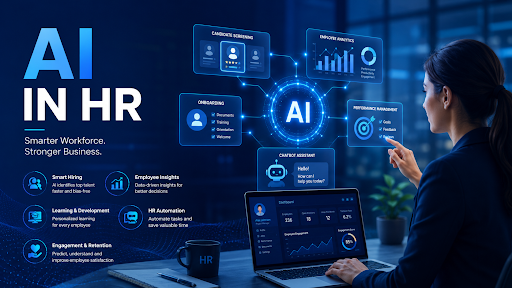
Human resources organizations are under increasing pressure to improve workforce productivity, simplify employee services and make better people decisions while managing growing operational complexity. AI in HR is helping organizations respond by automating administrative activities, improving access to workforce information and enabling more data-driven HR operations. Within this transformation, AI in Payroll is becoming particularly important because payroll sits at the intersection of employee experience, workforce data, financial control and compliance.
Together, these capabilities can reduce repetitive work, identify exceptions earlier and improve how employees interact with HR and payroll services. The opportunity extends beyond automation to creating more connected workforce operations that provide HR leaders with better insights into workforce costs, capacity and performance.
This article explores how AI in HR and AI in Payroll are transforming workforce operations, their most valuable applications, business benefits and priorities for successful implementation.
What is AI in HR?
AI in HR refers to the application of artificial intelligence technologies across human resources processes such as recruitment, onboarding, employee services, workforce planning, learning and talent management.
These technologies include machine learning, predictive analytics, generative AI, intelligent automation and AI agents. They can analyze workforce information, automate repetitive activities, identify patterns and provide recommendations that support HR decisions.
Rather than replacing HR professionals, AI can reduce administrative workloads and enable teams to focus more capacity on workforce strategy, employee development and business partnering.
What is AI in Payroll?
AI in Payroll refers to the application of artificial intelligence across payroll processing, validation, exception management, employee support and payroll analytics.
Payroll teams typically manage large volumes of employee and financial information under strict processing deadlines. AI can analyze this information to identify unusual transactions, automate routine workflows and direct payroll professionals toward exceptions requiring further investigation.
Generative AI can also improve employee self-service by helping employees understand payroll policies, pay information and common payroll processes through natural-language interactions.
Why AI in HR and payroll matters
HR and payroll processes are closely connected throughout the employee lifecycle. Hiring, compensation changes, working hours, leave and employee departures can all affect payroll, making consistent workforce information critical.
Disconnected systems and manual handoffs can create additional administrative work and increase the potential for data inconsistencies.
AI in HR can improve how workforce information is managed and analyzed, while AI in Payroll can use that information to streamline payroll processes and identify potential issues. Connecting both areas creates an opportunity to improve end-to-end workforce operations rather than optimizing individual processes separately.
Core technologies enabling intelligent workforce operations
Several AI technologies are changing HR and payroll processes.
Generative AI
Generative AI can draft employee communications, summarize HR cases, explain policies and provide conversational access to workforce and payroll information.
Machine learning
Machine learning analyzes workforce and payroll data to identify patterns, anomalies and trends that may require attention.
Predictive analytics
Predictive analytics can help organizations anticipate hiring requirements, workforce capacity, employee retention trends, payroll expenses and overtime patterns.
Intelligent automation
Automation can streamline employee record updates, workflow routing, approvals, payroll validation and other repetitive administrative activities.
AI agents
AI agents represent an emerging capability that can potentially coordinate multistep HR and payroll processes across enterprise systems while escalating sensitive or higher-risk decisions to employees.
Together, these technologies can create more connected and responsive workforce operations.
Key use cases of AI in HR
Organizations can apply AI across multiple stages of the employee lifecycle.
Talent acquisition
AI can summarize candidate information, assist with job descriptions, coordinate recruitment activities and support candidate screening while maintaining appropriate human oversight.
Employee onboarding
AI can guide employees through onboarding activities, automate documentation and provide immediate access to relevant policies and information.
Employee self-service
AI-powered assistants can answer routine questions about benefits, leave, workplace policies and other HR services.
Learning and development
Generative AI can help create learning materials and personalize development recommendations based on employee roles and skills requirements.
Workforce planning
AI can analyze workforce demand, skills, capacity and business requirements to support more informed hiring and talent decisions.
These applications demonstrate how AI in HR can improve both HR productivity and the employee experience.
Key use cases of AI in Payroll
AI in Payroll can address several high-volume and data-intensive activities.
Payroll validation
AI can analyze payroll information before processing to identify unusual values, missing information and potential inconsistencies.
Exception management
AI can classify payroll exceptions, summarize relevant information and route issues to the appropriate specialist for investigation.
Time and attendance analysis
AI can compare attendance, leave and overtime information to identify discrepancies that may affect employee pay.
Employee payroll support
Generative AI can answer routine questions about pay statements, deductions and payroll policies, reducing basic inquiries handled manually by payroll teams.
Payroll analytics
AI can analyze payroll costs, overtime patterns and other workforce expenses to support financial and workforce planning.
These capabilities can help payroll teams move from manual review toward more exception-driven operations.
Business benefits of AI in HR and payroll
Connecting AI across HR and payroll can improve several dimensions of workforce performance.
Greater productivity
Automation reduces repetitive administrative work and enables HR and payroll professionals to focus on higher-value activities.
Improved employee services
Faster access to workforce and payroll information can reduce response times and make common employee interactions easier to manage.
Better workforce insights
Integrated HR and payroll information can provide leaders with greater visibility into workforce costs, capacity, skills and organizational trends.
More consistent processes
Intelligent workflows can help standardize HR and payroll activities across business units and locations.
Stronger exception management
AI can continuously analyze transactions and workforce information, helping teams focus attention on issues that require specialist judgment.
How AI in Payroll strengthens broader HR transformation
Payroll generates important information about workforce costs, compensation, overtime and organizational structures. When this information is connected with broader HR data, organizations can gain a more complete understanding of workforce performance.
For example, HR leaders can combine payroll information with workforce planning to understand how hiring decisions affect labor costs. Compensation information can be analyzed alongside retention and skills data to inform talent strategies.
AI in Payroll therefore has value beyond transaction processing. Integrated effectively, it can contribute to broader AI in HR initiatives by providing workforce intelligence that supports strategic decisions.
Best practices for implementing AI across HR and payroll
Successful implementation requires organizations to address data, processes, technology and governance together.
- Identify HR and payroll processes where AI can materially improve productivity or employee service.
- Standardize workforce and payroll data before scaling advanced AI capabilities.
- Integrate HR, payroll, time management and finance systems where appropriate.
- Prioritize use cases based on business impact, complexity and time to value.
- Establish strong controls for employee privacy, cybersecurity and data access.
- Maintain human accountability for hiring, compensation, payroll approvals and other sensitive decisions.
- Measure outcomes through productivity, processing time, exception rates, employee service levels and workforce performance.
This approach helps organizations scale AI while maintaining the controls required for sensitive workforce processes.
Challenges organizations need to address
AI in HR and AI in Payroll involve highly sensitive employee information. Organizations therefore need strong governance covering privacy, security, data access and responsible AI.
Data quality is another significant challenge. Inconsistent employee records across HR, payroll and time systems can limit AI effectiveness and create unreliable outputs.
Organizations also need to consider fairness and transparency when AI supports workforce decisions. Employees and managers should understand when AI is being used and where human judgment remains responsible for the final decision.
Legacy technology may create additional integration challenges, particularly for organizations operating multiple HR and payroll platforms across regions.
The future of AI in HR and payroll
The next phase of workforce transformation will increasingly involve AI agents capable of coordinating activities across HR, payroll and other enterprise systems.
For example, an agent could identify an approved employee change, determine which downstream systems need updating, initiate authorized actions and escalate exceptions to the appropriate HR or payroll specialist.
Generative AI will also make workforce information more accessible by enabling employees and leaders to interact with HR and payroll data through conversational interfaces.
As these capabilities mature, organizations will need to redesign workflows, roles and governance around a working environment where employees and intelligent technologies operate together.
Conclusion
AI in HR is creating opportunities to improve workforce productivity, employee services and strategic people decisions. AI in Payroll strengthens this transformation by bringing intelligence and automation to one of the most data-intensive and business-critical workforce processes.
Organizations that connect HR and payroll transformation, strengthen workforce data and maintain appropriate governance will be better positioned to create integrated and future-ready workforce operations. The long-term opportunity is not simply greater automation, but a more intelligent HR environment that improves employee experience while supporting enterprise performance.