
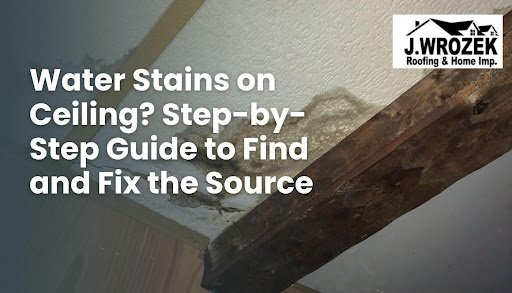
Waking up to a mysterious yellow or brown ring on your bedroom ceiling is a homeowner’s nightmare. In Jackson County, where heavy snow melts and sudden spring downpours are the norm, these stains are often the first “distress signal” your home sends.
While a stain on the ceiling is an interior problem, the source is almost always outside. Whether it’s a failure in your roofing, aging window installation, or inadequate attic insulation, finding the source quickly is the only way to prevent structural rot and mold. Here is your step-by-step guide to diagnosing and fixing the leak.
1. Trace the “Drip Path” in the Attic
Water rarely travels in a straight line. Gravity pulls it down the slope of your roof, where it may run along a rafter for ten feet before finally dripping onto your ceiling drywall. To find the true source, you must go into the attic with a high-powered flashlight during a rainstorm (or shortly after). Look for “shiners”—nails that missed the rafter and are now white with frost or orange with rust—as these are common entry points for moisture.
2. Inspect the Roof “Penetrations”
Statistically, 90% of roof leaks occur at “penetrations”—anywhere something pokes through the roof. This includes chimney flashing, plumbing vent boots, and attic fans. In Michigan’s extreme temperature swings, the rubber seals (boots) around these pipes crack and perish long before the shingles do. If your stain is near a bathroom or kitchen, a localized roof leak repair service in Michigan can often swap these boots out in under an hour.
3. Evaluate Your Attic Insulation and Ventilation
Sometimes, a water stain isn’t caused by a hole in the roof, but by “attic rain.” This happens when warm, moist air from your living space escapes into a cold attic due to poor attic insulation. That moisture condenses on the underside of the roof deck, freezes into frost, and then melts all at once when the sun hits the roof. If your insulation is thin or uneven, you aren’t just losing heat—you’re creating a man-made leak.
4. Check for Ice Dam Damage
If you noticed the stain during a winter thaw, you likely have an ice dam. When heat escapes through the top of your roof, it melts the snow, which then runs down and refreezes at the cold eaves. This “dam” of ice forces liquid water up under the shingles. This is a uniquely Michigan problem that requires a contractor who understands “Ice and Water Shield” barriers and proper eave protection.
5. Don’t Overlook Your Window Installation
If the water stain is located on the ceiling directly above a window or on the wall surrounding the frame, the roof might not be the culprit at all. Aging or poorly executed window installation can allow water to seep behind the exterior siding and travel across the header of the window frame. Check the exterior caulking and the “drip cap” (the metal flashing above the window) for gaps or corrosion.
6. The “Garden Hose” Test
If you can’t find the leak during a dry spell, you may need to simulate a storm. Have one person stay in the attic with a flashlight while another uses a garden hose on the roof. Start low—near the gutters—and work your way up slowly. Be patient; it can take several minutes for the water to soak through the layers of shingles and underlayment before it becomes visible inside.
7. Assessing Shingle Integrity
Look for shingles that are “bridging” or buckled. When asphalt shingles reach the end of their lifespan in Jackson County, they lose their ability to lay flat. Wind-driven rain can be blown upward under these buckled shingles. If you see widespread curling, a simple patch won’t suffice; you likely need a professional roof leak repair service in Michigan to evaluate if the decking underneath is still structurally sound.
8. Check Your Siding and Fascia Boards
Water can be deceptive. Sometimes rain hits the side of the house, enters through a crack in the siding or a gap in the fascia board (the trim behind your gutters), and then wicked into the soffit and onto your interior ceiling. Ensure your gutters are clean and not overflowing, as “splash back” is a leading cause of fascia rot and subsequent interior water stains.
9. Structural Risks of Ignoring the Stain
A water stain is more than an eyesore; it’s a warning of potential mold growth and weakened drywall. Drywall that stays damp loses its structural integrity and can eventually collapse. Furthermore, wet insulation loses its R-value, meaning your heating and cooling bills will climb as your home’s “envelope” is compromised.
10. When to Call a Professional Michigan Contractor
While a homeowner can identify many of these signs, climbing a ladder—especially on a damp or steep roof—is dangerous. Furthermore, an amateur “caulk-everything” approach often traps moisture inside the home, making the rot worse. A professional knows how to create a “shedding” system where every layer of the house overlaps the one below it correctly.
Why Trust J. Wrozek Roofing & Home Imp.?
Finding a leak is a science; fixing it so it never returns is an art. Since 1994, J. Wrozek Roofing & Home Imp. has been solving the toughest moisture problems in Jackson County. We don’t just “patch” a hole; we look at the big picture.
Is the leak caused by a shingle failure? Is your window installation letting in driving rain? Or is your attic insulation so poor that you’re dealing with internal condensation? As an owner-operated local business, Jason Wrozek personally ensures that every roof leak repair service in Michigan we perform is done with the highest grade materials and a 30-year legacy of expertise.
Get Your Free Leak Evaluation Today
Don’t wait for the next Michigan thunderstorm to turn that small ceiling stain into a major repair bill. Protect your home and your family’s health by identifying the source now.
Contact J. Wrozek Roofing & Home Imp. today for a professional inspection. We’ve protected over 5,000 Jackson County homes—let us protect yours.