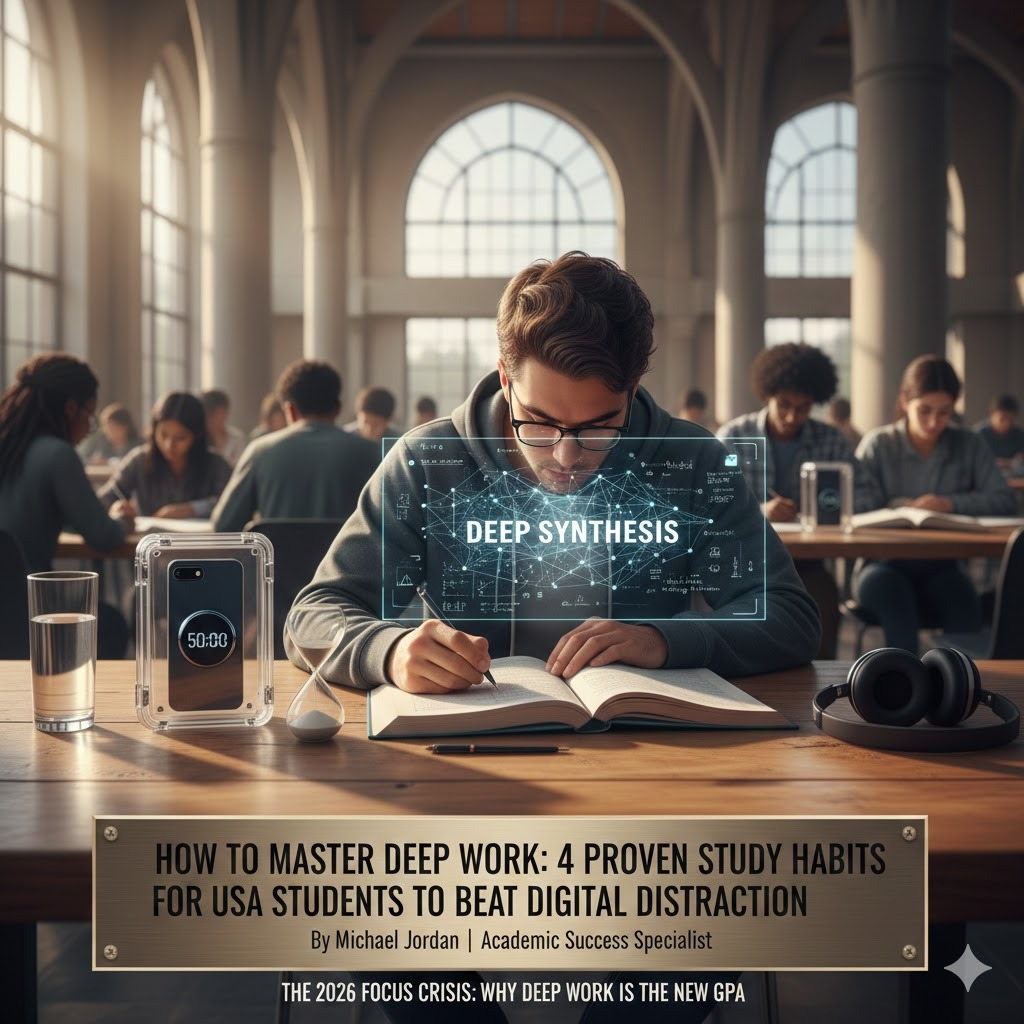
The 2026 Focus Crisis: Why Deep Work is the New GPA
In the modern American classroom—from high school AP courses to Ivy League lecture halls—a silent war is being waged. On one side is the ambitious student striving for academic excellence; on the other is the most sophisticated distraction machine ever built: the smartphone.
As an Academic Success Specialist, I have tracked the shift in student performance through the 2025 school year. As of early 2026, the landscape has shifted. Over 30 US states have now enacted strict cell phone restrictions in schools to combat “cognitive fragmentation.” With 55% of US schools now adopting “bell-to-bell” bans, the ability to focus is no longer just a skill—it’s a high-value competitive advantage.
What is Deep Work?
Coined by Professor Cal Newport and refined by modern productivity researchers, Deep Work is the ability to focus without distraction on a cognitively demanding task. It is a state where your brain functions at peak capacity, allowing you to master complex subjects like Organic Chemistry or AP Calculus in significantly less time than traditional “distracted” studying.
1. Build a “Physical Fortress” for Focus
Through years of coaching honors students, I’ve observed that the environment dictates behavior. If you study in bed, your brain is wired to relax; if you study at a desk covered in gaming gear, your brain is wired for dopamine.
- The Library Anchor: Use a specific floor of your school library solely for high-stakes preparation (e.g., SAT/ACT prep or final exam cramming).
- The “Analog” Zone: Create a desk space where digital devices are physically banned. Research confirms that “phone separation anxiety” only subsides when the device is in a different room, not just face down.
2. Implement Time-Blocking and “Monastic” Sprints
Vague goals like “I’ll study tonight” are the enemies of the GPA. Instead, use Time-Blocking to treat your study sessions like non-negotiable appointments.
- The 90-Minute Sprint: Research shows elite academic performers rarely exceed 4 hours of true deep work per day. Aim for two high-quality 90-minute sessions. These sessions are perfect for high-level tasks like researching Statistics project ideas or drafting complex thesis statements that require uninterrupted concentration.
- The Cost of Task-Switching: Every time you check a notification, you reset your “flow state” timer. It takes approximately 20 minutes to re-enter deep concentration after a single 30-second distraction.
3. Minimize Cognitive Load via Academic Delegation
A major barrier to deep work is “shallow” overwhelm. When a student is buried under minor formatting rules, bibliography busywork, or repetitive research sorting, they burn the mental energy required for high-level concept mastery.
To maintain a “flow state,” I advise my students to prioritize their Deep Work for core concepts and utilize professional support for administrative academic tasks. Using reputable assignment help from Myassignmenthelp.com for complex formatting, structural editing, or citation management allows your brain to remain fresh for the complex problem-solving required in 2026’s competitive environment.
4. Leverage “Pomodoro 2.0” Tools
To build your “focus muscle,” I recommend these industry-standard tools currently favored by US honors and graduate students:
- Hard-Blockers: Use apps like Freedom or Cold Turkey to lock social media across all synced devices.
- The 50/10 Rule: Work for 50 minutes of intense focus followed by a 10-minute “analog” break (no screens, just movement or hydration).
Frequently Asked Questions
Q.1 How do I start deep work if I have a short attention span?
Start small. Commit to 20 minutes of “phone-in-drawer” work and increase your timer by 5 minutes every day.
Q.2 Is Deep Work better than pulling an “all-nighter”?
Absolutely. High-intensity focus for 2 hours yields better retention and better grades than 8 hours of “pseudo-studying” fueled by caffeine and distractions.
Q.3 Why is focus considered a “superpower” in 2026?
As generative AI handles basic information retrieval, human value now lies in Deep Synthesis—the ability to connect complex ideas. This requires a level of focus that most of your peers are losing to digital noise.
About the Author
Michael Jordan is an educational consultant with over 10 years of experience helping US students navigate the pressures of high-stakes testing and Ivy League admissions. He specializes in productivity psychology and evidence-based study habits.